
Dizziness Can Have Many Possible Causes.
Let's Understand What
May Be Contributing.
Vertigo, lightheadedness, imbalance, or a sense that your surroundings are moving can arise for very different reasons. Our first priority is understanding the pattern of your symptoms, identifying relevant findings, and determining whether our approach — or another type of evaluation — is most appropriate.
Serving Raynham, MA and Southeastern Massachusetts.

What Could Be Contributing to Your Dizziness or Vertigo?
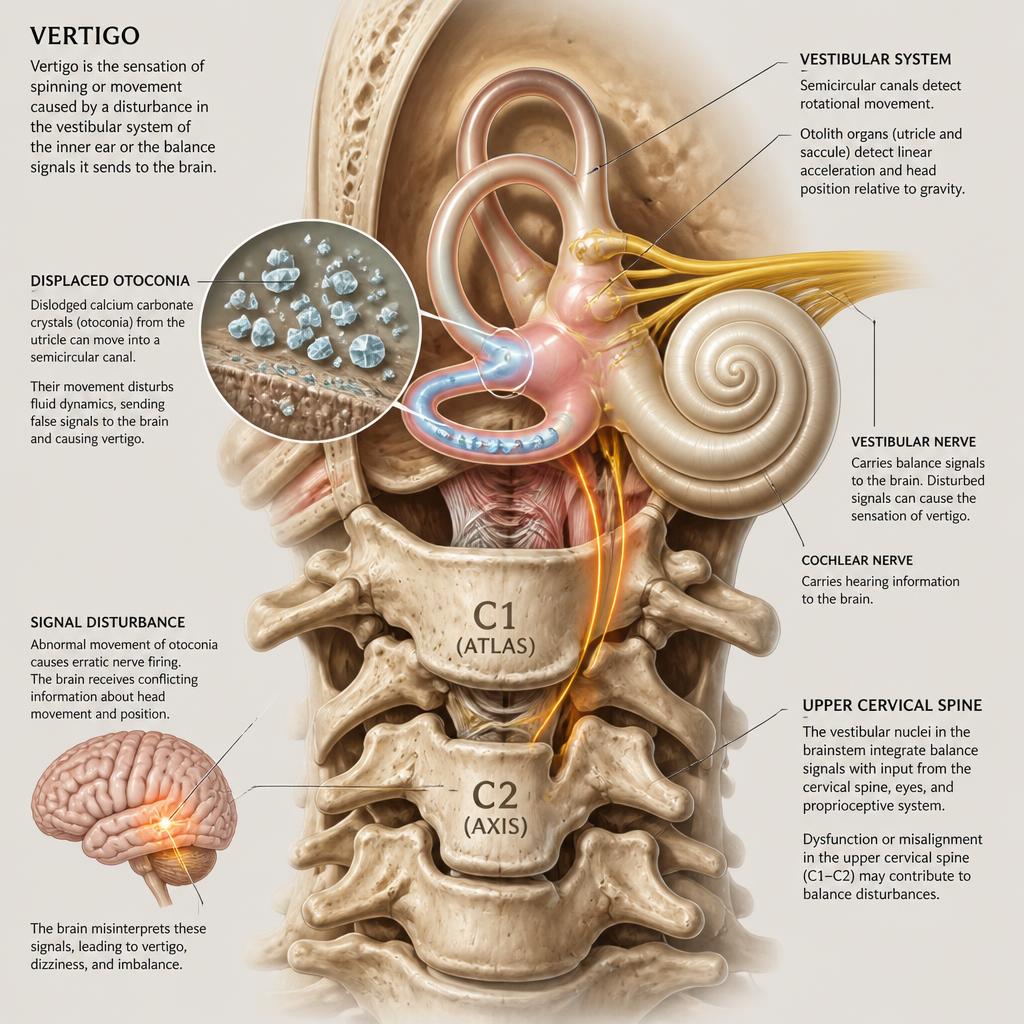
Balance & Vestibular Factors
The inner ear and vestibular system play an important role in balance and spatial orientation.
Neck & Movement Factors
Cervical motion, previous neck injury, and other musculoskeletal factors may accompany certain dizziness presentations.
Cranial-Facial & Breathing Factors
Cranial-facial mechanics, nasal function, pressure, and breathing-related findings may be considered as part of the overall evaluation.
Previous Head or Neck Injury
Concussion, whiplash, or other trauma may be relevant when dizziness begins or persists following an injury.
Dizziness and vertigo can arise from very different mechanisms, which is why understanding the pattern and determining whether referral or further evaluation is needed comes first.
Our Approach — A Broader Cranial, Cervical & Balance Lens
Our evaluation considers your dizziness pattern, balance, neck and cranial-facial findings, previous injuries, breathing and nasal factors, and other relevant findings. When appropriate, Cranial Facial Release (CFR) may be discussed as one component of an individualized care plan.
How we evaluate patients- Evaluate contributors
- Support cranial & cervical function
- Improve balance & function
This describes our evaluation-first framework. It is not a representation that any approach restores vestibular function or resolves vertigo.
Where Does Cranial Facial Release Fit?
Cranial Facial Release (CFR) is a specialized balloon-assisted endonasal cranial technique intended to open nasal breathing passages and mobilize cranial and facial structures. The CFR source material includes vertigo among the presentations for which the technique has been used. Here, CFR is presented only as a possible supportive consideration after evaluation — not as an established treatment or cure for vertigo or dizziness.
Learn more about Cranial Facial ReleaseWhat you can expect
Personalized Evaluation
A careful review of symptom timing, triggers, balance, relevant head and neck findings, previous injuries, and other factors that may help clarify the pattern.
Look Beyond One Cause
We do not assume that every dizzy or off-balance feeling has the same explanation or requires the same approach.
Honest Recommendations
CFR or other supportive approaches are discussed only when your evaluation suggests they may be appropriate.
Referral When Appropriate
Some dizziness presentations require medical, neurologic, vestibular, cardiovascular, or other evaluation. When that appears appropriate, we'll tell you.
How long does it take?
Every patient responds differently. The timeline below reflects general patterns and is provided for educational purposes only — not as a prediction of individual results.
- 1
First 1–2 weeks
The focus is on the evaluation itself — mapping your symptom pattern, balance, neck and cranial-facial findings, and any prior injury.
- 2
Weeks 2–6
Care is individualized to what the evaluation found, and referral is arranged if your findings suggest another type of workup.
- 3
Weeks 6–12
Findings are re-checked and recommendations adjusted based on how your symptoms and function are responding.
- 4
3–6+ months
Attention shifts to maintaining the neck, breathing, and daily habits that appear to influence your balance and confidence.
Hear From Patients Who Were Once Where You Are
Patients describe their own experiences with balance, confidence, concentration, and everyday activity.
The individuals featured are sharing their personal experiences. Individual responses to care vary, and these experiences should not be interpreted as a guarantee or representation that another patient will experience the same or similar results.
Answers
Dizziness Can Have Many Possible Causes. questions we hear most
Straight answers to what patients ask before their first visit. Don't see yours? Call us — we're happy to talk it through.
Ready to Take the Next Step?
If dizziness, vertigo, or imbalance is affecting your confidence, movement, work, exercise, or everyday activities, we'd be happy to evaluate your symptom pattern and discuss whether our approach — or another type of evaluation — may be appropriate.
Related: Cranial Facial Release (CFR) · Headaches · Neck pain · Nasal & breathing problems · Our approach · Patient stories
Important information: Information on this page is provided for general educational purposes and is not intended to diagnose, treat, cure, reverse, or prevent disease. Vertigo and dizziness can have many possible causes, including conditions requiring medical or urgent evaluation. Cranial Facial Release is not represented here as a proven treatment or cure for vestibular, neurologic, cardiovascular, or other causes of dizziness. Recommendations are made only after an individualized evaluation and when clinically appropriate. No specific outcome is guaranteed, and individual responses to care vary.