
Patient Clinical Evidence Series
Research & Clinical Evidence: Wharton's Jelly & Umbilical-Cord-Derived Interventions
An educational summary of the published human research, with a full review you can read and verify yourself. Current through September 2026.
We believe patients should be able to review the published evidence for themselves when they are considering regenerative-care options. This page exists so you can read the same research we discuss in the office — including the studies that are positive, the studies that are neutral, and the questions that remain unanswered.
The review below is an educational summary of the literature. It is not proof that any specific commercial product is safe or effective, and it does not replace an individualized evaluation or informed consent.
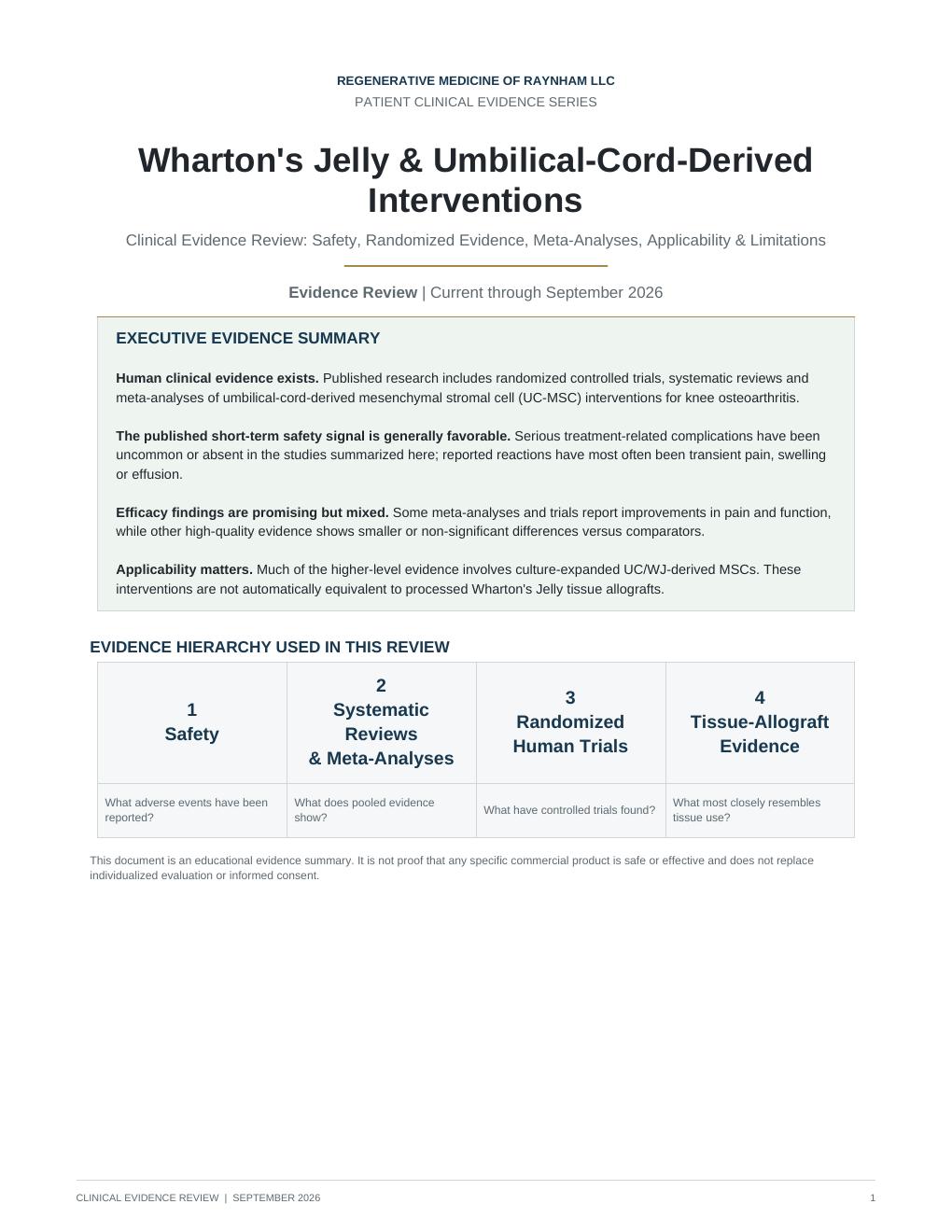 Preview
Clinical Evidence Review
Safety, randomized evidence, meta-analyses, applicability and limitations · PDF · Current through September 2026
Every citation in the review links directly to PubMed, the journal article or the relevant FDA information.
What the published evidence shows
Executive evidence summary
Human clinical research exists
The published literature includes randomized controlled trials, systematic reviews and meta-analyses of umbilical-cord-derived mesenchymal stromal cell interventions, particularly for knee osteoarthritis.
Short-term safety findings are generally favorable
Serious treatment-related complications have been uncommon or absent in the studies summarized. Reported reactions are most often transient pain, swelling or effusion. Long-term and product-specific safety are not fully established.
Efficacy findings are promising but mixed
Some trials and pooled analyses report meaningful improvements in pain and function, while other high-quality evidence shows smaller or non-significant differences compared with standard comparators.
Applicability matters
Much of the higher-level evidence studies culture-expanded umbilical-cord/Wharton's-Jelly-derived MSCs. Those interventions are not automatically equivalent to processed Wharton's Jelly tissue allografts.
Inside the review
What the document covers
- Safety profile in published human research
- Systematic reviews and meta-analyses
- Randomized controlled human evidence
- Evidence most directly relevant to tissue allografts
- What the evidence does — and does not — establish
- Regulatory context and outcomes accountability
- Selected references with direct links to the original publications
Regulatory context
The FDA states that regenerative medicine therapies, including Wharton's Jelly and other orthobiologics, have not been approved for the treatment of orthopedic conditions such as osteoarthritis or knee, hip, shoulder and back pain. This page and the linked review are educational. They are not a guarantee of safety, effectiveness or a particular clinical outcome, and individual results vary.
Related educational pages
If you would like to discuss whether any of these options may be appropriate for your situation, our first step is always an individualized evaluation. Request an evaluation.